In the United States, outdoor kitchens are seasonal additions — built for summer entertaining and covered through winter. They occupy a narrow window of usability, typically three to five months per year, which shapes everything from material choices to equipment investment.
In Mexico, the proposition is fundamentally different. From Mexico City’s mild, spring-like climate to coastal locations with 300 or more outdoor cooking days per year, an outdoor kitchen is not a seasonal luxury. It is a viable primary cooking space.
Yet almost no professional guidance exists in English on how to design, specify, and build an outdoor kitchen in Mexico. The search results for “outdoor kitchen Mexico” return exclusively American blogs about hacienda-themed barbecue areas — festive décor advice for US patios, not engineering guidance for a kitchen that will function daily in Baja’s desert sun or Mérida’s tropical humidity.
This article addresses the actual design considerations.
Why Mexico’s climate changes everything
The performance equation for an outdoor kitchen depends on two variables: how many days per year you can use it, and what conditions the materials must withstand.
In most of the United States, outdoor kitchens face a harsh cycle: extreme summer heat followed by freezing winters. Materials must survive thermal expansion and contraction, freeze-thaw cycles, and extended periods of disuse under protective covers. The investment is justified by perhaps 120 to 150 days of use.
Mexico eliminates the freeze-thaw problem entirely. But it introduces different challenges depending on location.
Mexico City (2,240 meters elevation). Year-round temperate climate with 250 to 280 usable outdoor days. The primary material concern is UV intensity — at this altitude, ultraviolet exposure is significantly greater than at sea level, accelerating color fade and surface degradation in materials not rated for UV resistance. Afternoon rain from June through October requires covered or partially covered configurations.
Los Cabos (desert/coastal). Near-constant sunshine with 340 to 350 usable days. The challenges are salt air corrosion, intense direct sun, and sand abrasion. Materials must resist salt spray, UV degradation, and surface scratching simultaneously.
Mérida and the Yucatán Peninsula (tropical humid). Year-round warmth with high humidity. Wood warps, natural stone absorbs moisture, and untreated metals corrode. Materials with near-zero porosity become essential, not optional.
Valle de Bravo (mountain lakeside). Temperate with cooler evenings. The outdoor kitchen serves weekend and vacation use in a setting where indoor-outdoor integration defines the architecture. Weather resistance requirements are moderate, but moisture from the lake environment affects material behavior.
In every case, the number of usable days far exceeds what any US location offers. This shifts the outdoor kitchen from a lifestyle accessory to a functional component of the home.
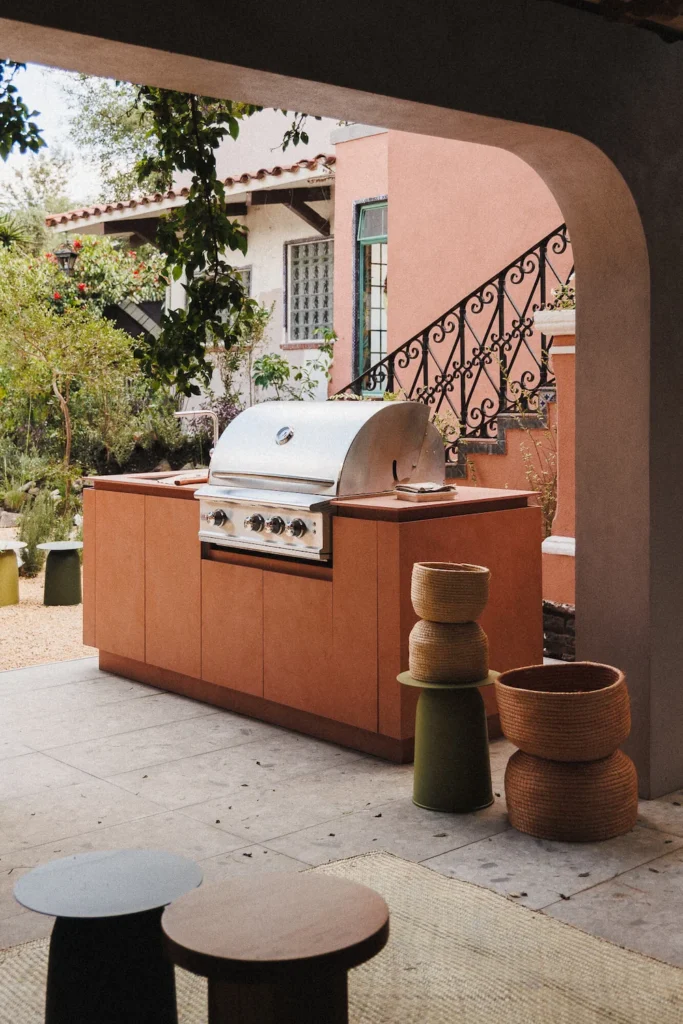
Material selection: what survives Mexico’s conditions
The material palette for an outdoor kitchen in Mexico must be evaluated against a more demanding set of conditions than most US applications require. Here is what works, and why.
Sintered stone (Dekton)
Dekton is a sintered stone surface manufactured by Cosentino under extreme heat and pressure, producing a material with near-zero porosity, exceptional UV resistance, and high resistance to thermal shock, scratching, and chemical staining.
For outdoor kitchens in Mexico, Dekton addresses every major climate challenge simultaneously. Its UV stability prevents fading at Mexico City’s high altitude. Its zero porosity resists moisture absorption in Mérida’s humidity. Its heat tolerance handles direct desert sun in Los Cabos without surface damage.
Dekton is available through Cosentino’s Mexico City showroom in Polanco, with a range of finishes that include concrete, marble, and stone appearances. It is the primary countertop surface specified for outdoor kitchen projects where long-term performance is the priority. For a full comparison of countertop materials available in Mexico, including indoor options, see our dedicated guide.
Aluminum structure
Unlike stainless steel — which corrodes in salt air environments and shows fingerprints and scratches in residential use — powder-coated aluminum provides structural durability with minimal maintenance. It resists corrosion in coastal conditions, maintains its finish under UV exposure, and weighs significantly less than steel, simplifying installation and reconfiguration.
Treated hardwoods
Mexican hardwoods such as tzalam offer natural resistance to insects and moderate weather resistance, making them suitable for exterior applications in covered or semi-covered configurations. However, all wood requires periodic maintenance in outdoor settings, and coastal or tropical environments accelerate weathering considerably.
Wood is best used for visual accent elements — drawer fronts, bar surfaces, shelving — rather than structural or countertop applications where engineered surfaces perform more reliably.
What does not work outdoors
Granite and marble. Natural stone is porous and absorbs liquids, leading to staining and bacterial growth in outdoor environments where cleaning is less controlled than indoors.
Cantera. Mexico’s iconic volcanic stone is widely used in architectural facades and decorative elements, but its high porosity makes it unsuitable for kitchen countertops — indoors or out.
MDF and standard wood composites. No moisture resistance. They delaminate rapidly in outdoor conditions.
Quartz composite (Silestone, Caesarstone). Engineered quartz surfaces are designed for indoor use. UV exposure causes resin degradation and color change over time. They are not recommended for exterior applications.
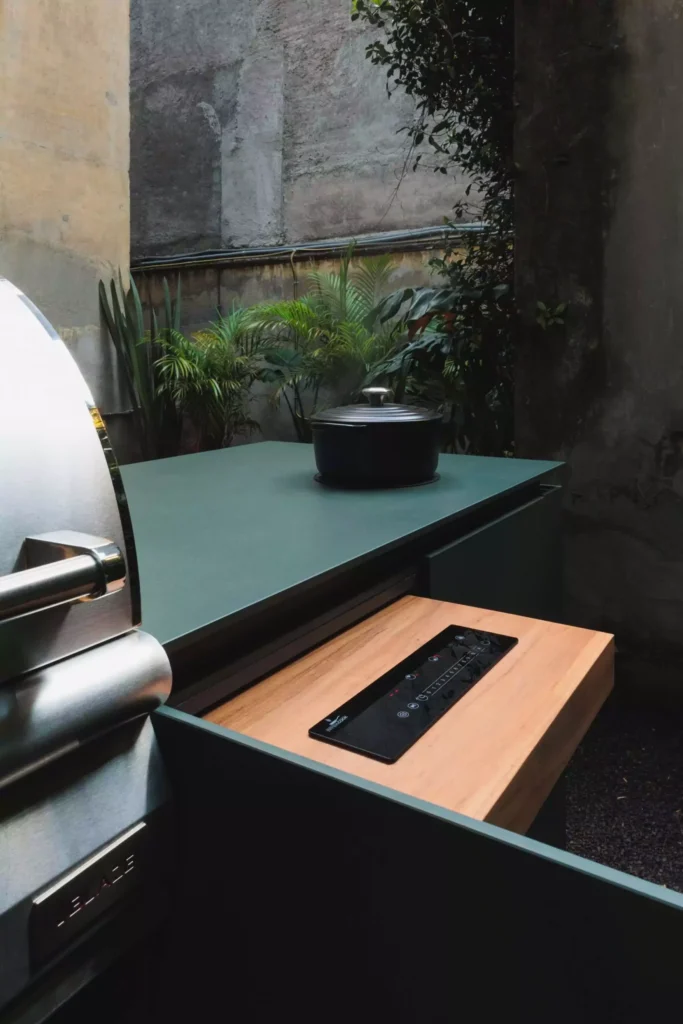
Modular systems versus custom fabrication
Outdoor kitchens in Mexico can be built as fully custom installations or assembled from modular systems. Each approach has trade-offs.
Custom fabrication allows complete adaptation to the site — irregular terraces, specific sight lines, integration with existing architecture. It is the appropriate choice when the outdoor kitchen must respond to a unique spatial condition. Custom projects require full design development, technical documentation, and on-site fabrication or assembly.
Modular systems offer a different advantage: tested configurations, controlled manufacturing quality, and the ability to reconfigure or relocate components over time. A well-designed modular outdoor kitchen consists of standardized units — cooking module, sink module, storage module, bar extension — that can be combined in multiple arrangements.
The modular approach is particularly relevant for properties where the outdoor kitchen may need to adapt to changing needs: a weekend home that becomes a primary residence, a rental property that benefits from a fully equipped outdoor area, or a terrace where future expansion is likely.
Configuration options
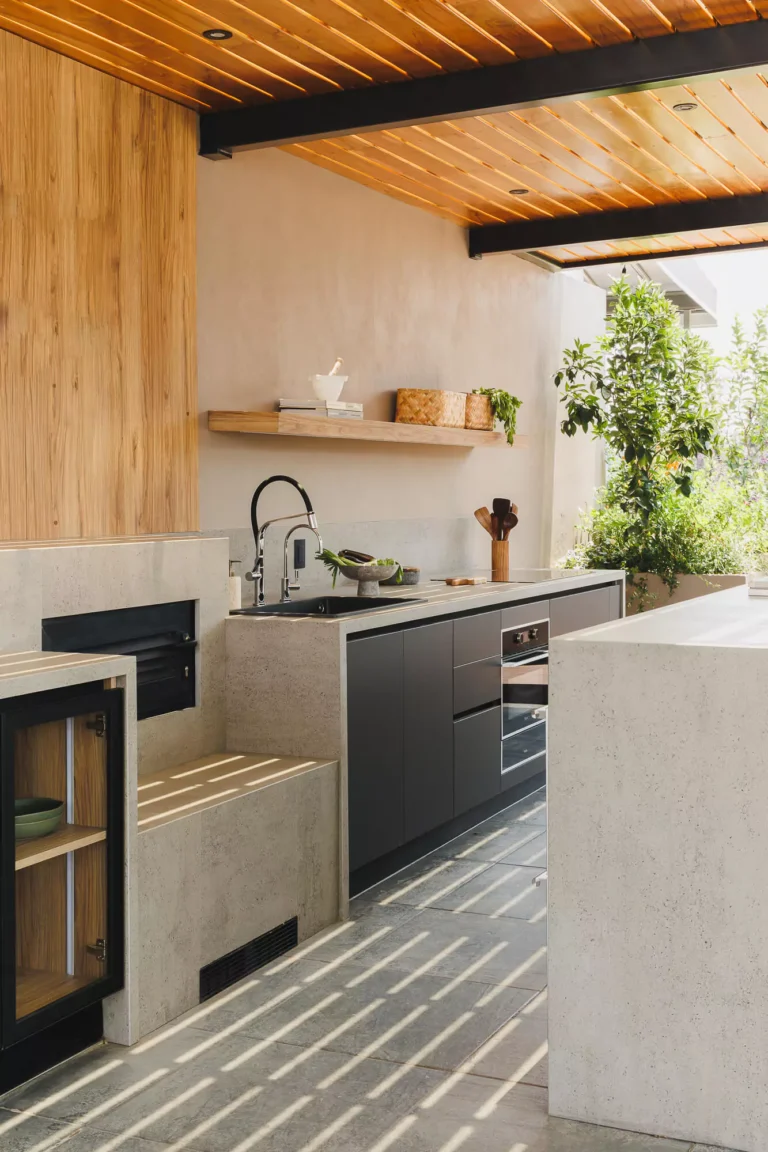
A practical outdoor kitchen typically includes four to six functional zones:
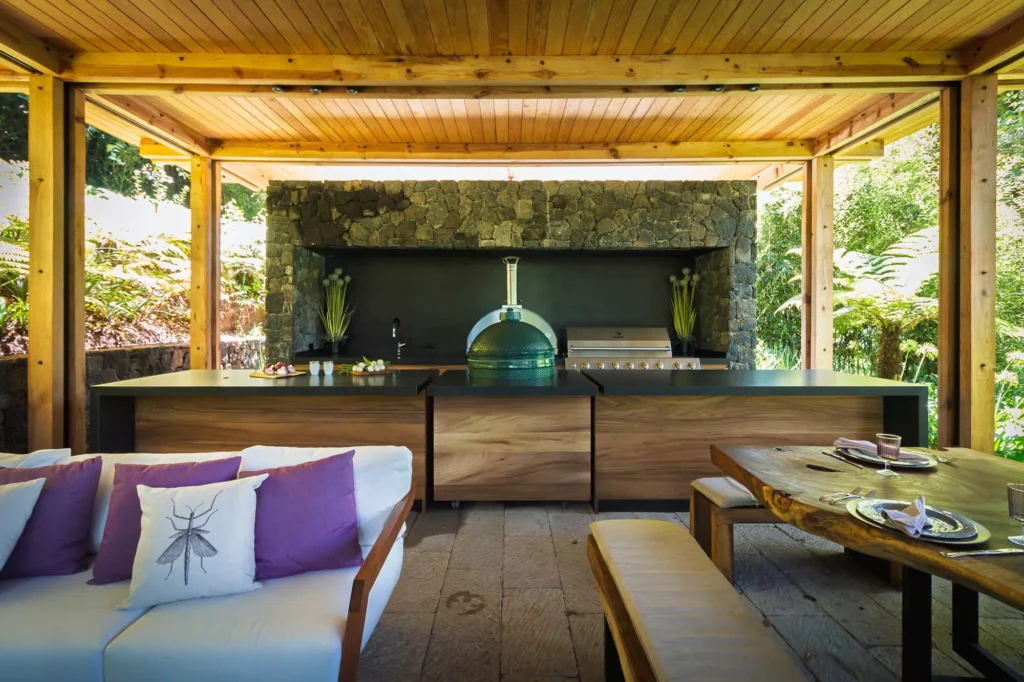
Cooking. A high-performance grill or kamado for direct-heat cooking. Ceramic kamados (such as Big Green Egg or Kamado Joe) are increasingly popular in Mexico for their fuel efficiency and versatility.
Preparation. A counter surface with adequate workspace for food preparation, ideally adjacent to the cooking zone.
Washing. A sink with running water, connected to the home’s plumbing system or to a dedicated water line.
Cold storage. An outdoor-rated refrigerator or beverage center. Standard indoor refrigerators are not designed for outdoor temperature and humidity conditions.
Bar or serving area. Counter space with seating for casual dining or entertaining.
Storage. Closed cabinets with weather-resistant doors for utensils, fuel, cleaning supplies, and accessories.
The configuration depends on available space, cooking habits, and how the outdoor kitchen relates to the indoor kitchen. In Mexico City terraces and rooftops, compact three-module configurations are common. In Valle de Bravo or Los Cabos, where outdoor space is generous, full six-module installations create a complete second kitchen.

Planning considerations for specific locations
Mexico City terraces and rooftops
Weight loading is the primary constraint. Reinforced concrete rooftops can typically support outdoor kitchen installations, but a structural assessment is advisable for large configurations. Water supply and drainage must be routed from interior plumbing. Gas connections require compliance with CDMX regulations and should be installed by a certified technician.
Partial coverage — a pergola, retractable awning, or architectural overhang — extends usability through the rainy season and protects equipment from direct afternoon sun.
Coastal properties (Los Cabos, Puerto Vallarta, Riviera Maya)
Salt air accelerates corrosion of any unprotected metal. Stainless steel hardware should be marine-grade 316, not standard 304. Aluminum and sintered stone surfaces resist salt corrosion effectively. Ensure all electrical connections are waterproof-rated and that drainage handles tropical downpours without pooling.
Wind exposure is a factor in Baja California. Equipment placement should consider prevailing wind direction to manage smoke, ash, and grill performance.
Mountain and lake properties (Valle de Bravo, Avándaro)
Cooler evenings make radiant heating elements or fire pit integration valuable additions. Wood is more viable here than in coastal settings, though periodic sealing is still required. The damp mountain environment can produce condensation on cold stone surfaces in early morning — a minor consideration but one that affects daily usability.
The value proposition: investment, not expense
An outdoor kitchen in Mexico represents a different kind of investment than the same installation in the United States. In the US, the return depends on a short annual use window and on whether the buyer values outdoor entertaining. In Mexico, the use window is essentially year-round, and the outdoor lifestyle is not optional — it is expected.
For properties marketed to international buyers — in Los Cabos, San Miguel de Allende, Mérida, or Puerto Vallarta — a well-designed outdoor kitchen is increasingly a standard expectation at the premium price tier, not a distinguishing amenity. Properties without outdoor cooking and entertaining areas are beginning to feel incomplete.
For primary residences in Mexico City, the outdoor kitchen extends the functional footprint of the home without construction permits or structural modification. A terrace or garden that was previously unused becomes a daily-use space.
Frequently asked questions
Can an outdoor kitchen be used year-round in Mexico?
Yes. Mexico City’s temperate climate supports 250 to 280 outdoor cooking days per year. Coastal and tropical locations offer 300 to 350 days. With partial coverage for rain protection, year-round use is practical in most of Mexico.
What is the best countertop material for an outdoor kitchen in Mexico?
Sintered stone surfaces such as Dekton offer the best combination of UV resistance, zero porosity, heat tolerance, and scratch resistance for Mexico’s varied climate conditions. Natural stone, quartz composite, and wood are not recommended for outdoor countertop applications.
How much does an outdoor kitchen cost in Mexico?
A modular outdoor kitchen with quality materials starts at approximately $250,000 MXN ($14,000 USD). Custom installations with premium equipment and materials range from $400,000 to $1,000,000+ MXN ($22,000 to $55,000+ USD) depending on size and complexity.
Do I need a gas line for an outdoor kitchen?
Most outdoor grills and cooktops can operate on either natural gas or propane (LP gas). Natural gas connections require professional installation and compliance with local gas regulations. Propane tanks offer more flexibility for locations where running a gas line is impractical.
Can I install an outdoor kitchen on a rooftop terrace in Mexico City?
Yes, provided the structure supports the weight load. A structural assessment is recommended for larger installations. Water, drainage, and gas connections will need to be routed from the building’s existing systems.
Explore the Fuori outdoor kitchen
If an outdoor kitchen is part of your project in Mexico, explore the Fuori modular system — designed for year-round performance with sintered stone surfaces and aluminum construction.