Choosing a countertop material is one of the most consequential decisions in a kitchen project. It determines how the surface performs under daily use, how it ages, how it’s maintained, and — to a significant degree — how the kitchen looks and feels.
For homeowners renovating or building in Mexico, the decision carries an additional layer of complexity. Mexico’s climate conditions vary dramatically by region, and materials that perform well in a temperature-controlled US kitchen may behave differently at altitude in Mexico City, in the salt air of Los Cabos, or in the humidity of Mérida. At the same time, Mexico’s material market includes options — local hardwoods, volcanic stones, and regionally-sourced surfaces — that are simply not available in North America.
This guide compares the countertop materials most commonly specified in high-end Mexican kitchens, evaluated on the criteria that matter for long-term performance: durability, maintenance, climate suitability, aesthetics, and availability.
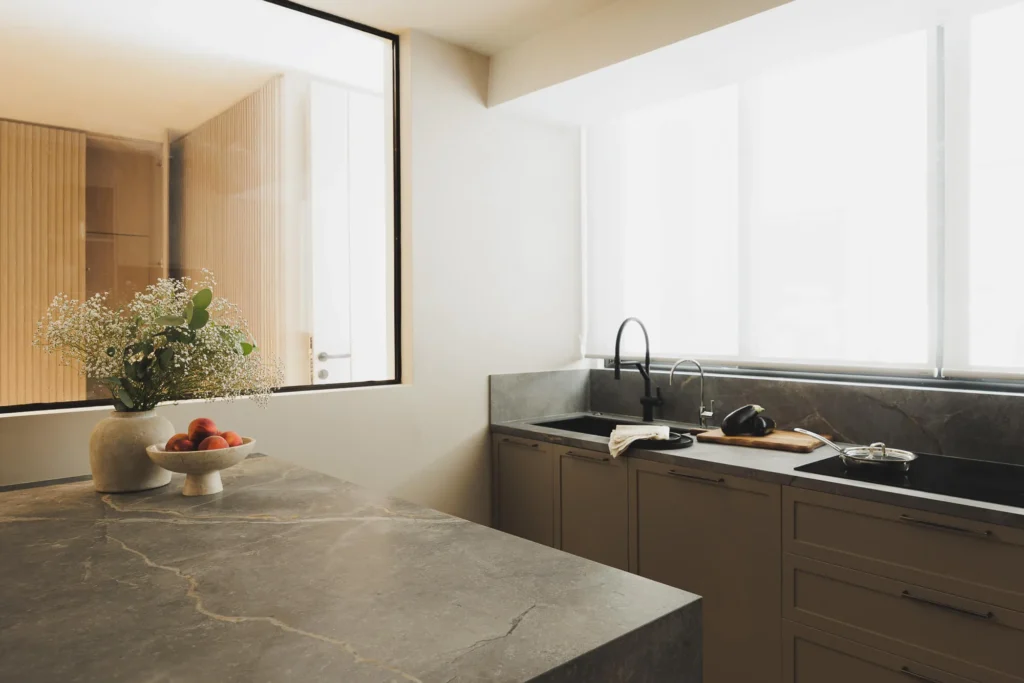
Sintered stone: Dekton, Neolith, and Lapitec
Sintered stone is produced by subjecting a blend of raw minerals to extreme heat and pressure — replicating in hours the geological process that forms natural stone over millennia. The result is an ultracompact surface with near-zero porosity, exceptional hardness, and resistance to UV radiation, heat, scratching, and chemical staining.
Dekton by Cosentino is the most widely specified sintered stone in Mexico, available through Cosentino’s showroom in Polanco, Mexico City. The range includes finishes that replicate marble, concrete, metal oxide, and natural stone appearances, in both matte and textured surfaces.
Performance characteristics
Heat resistance. Dekton withstands direct heat without scorching, cracking, or discoloring. You can place a hot pan on the surface without a trivet — a practical advantage in a working kitchen.
UV stability. Unlike quartz composite, sintered stone does not degrade under ultraviolet exposure. This makes it the only engineered surface appropriate for both indoor and outdoor applications — a critical consideration at Mexico City’s 2,240-meter altitude, where UV intensity is substantially greater than at sea level.
Zero porosity. Sintered stone does not absorb liquids. Wine, coffee, citrus juice, and cooking oils can be wiped from the surface without staining. No periodic sealing is required.
Scratch resistance. Rated 8 on the Mohs hardness scale (granite rates 6–7, quartz composite 5–7), sintered stone resists scratching from knives, abrasive cleaning, and daily impact.
Where it works best in Mexico
Sintered stone is appropriate for every climate zone in Mexico. Its zero porosity handles Yucatán humidity. Its UV resistance handles Baja California sun. Its thermal stability handles the daily temperature swings in highland locations. It is the only countertop material that performs equally well indoors, outdoors, in coastal settings, and at altitude.
Considerations
Cost is higher than most alternatives — typically 20 to 40 percent more than premium quartz for equivalent coverage. Installation requires specialized cutting and handling equipment. Availability of certain colors and finishes may involve lead times of four to six weeks.
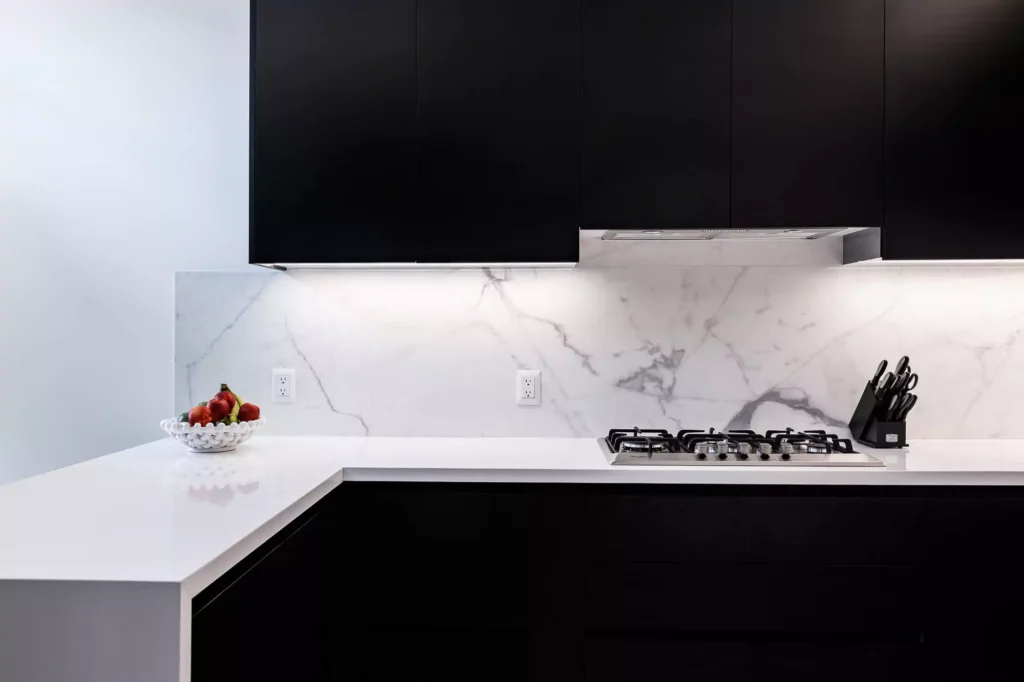
Engineered quartz: Silestone, Caesarstone, and Compac
Engineered quartz is a composite material made from approximately 90 percent natural quartz bound with polymer resins. It is manufactured in controlled conditions, producing a surface that is consistent in color, non-porous, and available in an extensive range of appearances — including convincing reproductions of marble, concrete, and natural stone.
Performance characteristics
Stain resistance. The resin binding makes quartz non-porous and resistant to most household stains. No sealing required.
Consistency. Unlike natural stone, every slab of a given color is virtually identical. This is an advantage when matching surfaces across large kitchens or open-plan spaces.
Maintenance. Daily cleaning requires only mild soap and water. Quartz is one of the easiest surfaces to maintain.
Limitations
UV sensitivity. The polymer resins in quartz composite degrade under prolonged ultraviolet exposure, causing yellowing and color shift. This is not a concern for interior kitchens, but it makes quartz unsuitable for outdoor countertops or surfaces near large windows with direct sun exposure.
Heat sensitivity. Quartz can be damaged by direct heat from hot pans. Trivets are required.
Repairability. Chips and cracks in quartz are difficult to repair invisibly. Damaged sections typically require full slab replacement.
Availability in Mexico
Silestone (also by Cosentino) is widely available through the same Polanco showroom. Caesarstone has distribution in Mexico through authorized dealers. Both offer professional specification services and installation support.
Where it works best in Mexico
Quartz is an excellent choice for interior kitchens in any Mexican city. It should not be used for outdoor applications, near skylights with direct sun, or in environments where UV exposure is a concern.
Granite and natural stone
Granite remains popular in Mexican kitchens, particularly in traditional and transitional designs. Mexico sources granite domestically and imports it from Brazil, India, and China, giving buyers a wide range of colors and patterns.
Performance characteristics
Hardness. Granite is naturally hard and scratch-resistant.
Heat tolerance. Handles hot pans without damage.
Aesthetic variety. Each slab is unique — the veining, crystal patterns, and color variations are one-of-a-kind.
Limitations
Porosity. Granite is a natural material with microscopic pores. It requires periodic sealing — typically every one to two years — to prevent staining. Without maintenance, wine, oil, and acidic liquids can penetrate the surface.
Weight. Granite is heavy. Cabinet structures must support the load, and installation requires specialized handling.
Inconsistency. The natural variation that makes each slab unique also means that the slab you select in the warehouse may differ from the one installed in your kitchen. Edge matching across multiple slabs requires careful selection.
Where it works best in Mexico
Granite is most appropriate for interior kitchens in temperate climates (Mexico City, Querétaro, San Miguel de Allende) where humidity-driven moisture absorption is less of a concern. In humid coastal environments, the maintenance burden increases. Not recommended for outdoor applications.
Mexican stones: cantera, recinto, and travertine
Mexico has a rich tradition of working with local stone — cantera, recinto volcánico, and travertino — in architectural and decorative applications. Understanding their properties prevents a common mistake: specifying a beautiful stone in the wrong application.
Cantera
Cantera is a volcanic stone quarried throughout central Mexico, prized for its warm tones and workability. It is widely used in facades, columns, fountains, and decorative elements. However, cantera is highly porous and relatively soft. It absorbs liquids readily, stains easily, and is not resistant to the acids present in common kitchen substances (citrus, vinegar, wine). It is not recommended for kitchen countertops.
Recinto volcánico
A denser volcanic stone than cantera, recinto offers better performance in wet environments and is traditionally used for floors, sinks, and exterior paving. Its dark, textured surface can work as a backsplash or accent material, but its porosity still makes it a poor choice for primary countertop surfaces.
Travertine
Mexican travertine, quarried primarily in Puebla and Durango, offers a warmer, more organic appearance than European varieties. When filled, honed, and sealed, it can function as a countertop material in low-use applications. However, it requires vigilant maintenance, is vulnerable to acid etching, and should not be considered for a kitchen that sees daily cooking.
The honest assessment
These stones are part of Mexico’s architectural identity, and they deserve to be used well — which means using them where they perform best: walls, floors, facades, and decorative elements. For kitchen countertops where performance, hygiene, and durability are paramount, engineered surfaces outperform natural Mexican stone decisively.
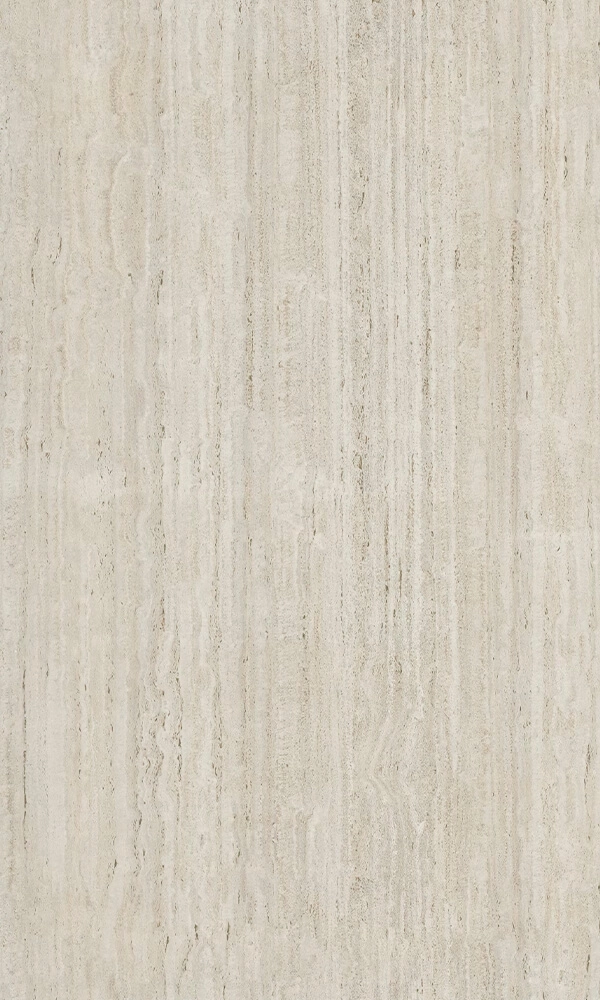
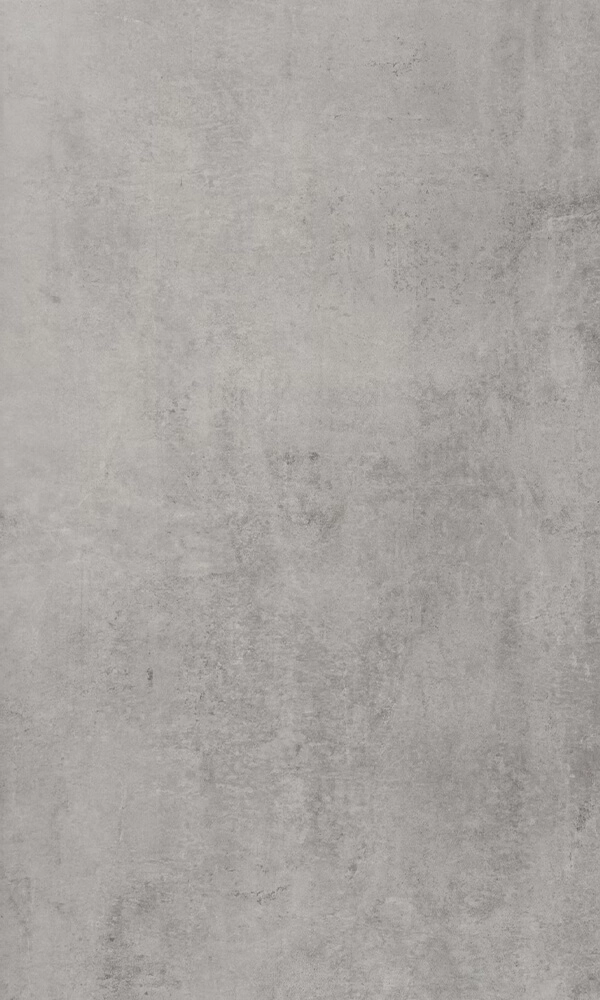

Dekton finishes available through Cosentino’s Polanco showroom in Mexico City. From left: Kreta (marble appearance), Eter (concrete texture), Marmorio (veined stone). Each rated for indoor and outdoor use. Credit: Cosentino.
Climate-specific recommendations
The right countertop depends not only on your aesthetic preferences but on where in Mexico your kitchen is located.
Mexico City and highland cities (Querétaro, San Miguel de Allende, Puebla). All materials perform adequately indoors at altitude. If your kitchen receives direct sun through large windows, avoid quartz in those zones. Dekton and granite are both strong choices for indoor applications. For outdoor countertops on terraces or rooftops, sintered stone is the only responsible recommendation.
Coastal locations (Los Cabos, Puerto Vallarta, Cancún, Mérida). Humidity and salt air narrow the field. Sintered stone handles both conditions without maintenance. Quartz performs well indoors. Granite requires more diligent sealing schedules due to ambient moisture. Natural stone is not recommended in high-humidity coastal kitchens.
Mountain and lake properties (Valle de Bravo, Avándaro). Moderate humidity with cooler temperatures. All engineered surfaces perform well. Wood countertops (butcher block-style) can work as secondary surfaces in these environments, where extreme humidity is less of a concern than at the coast.
Sourcing countertop materials in Mexico
For English-speaking homeowners, sourcing can feel opaque. Here is where to start.
Cosentino (Dekton, Silestone). The Polanco showroom in Mexico City offers full material libraries, technical specification support, and access to the complete Dekton and Silestone collections. Cosentino also operates through a network of authorized fabricators who cut, finish, and install the surfaces.
Granite and natural stone. Mexico has an extensive network of stone yards (marmoleras) where slabs can be selected in person. Major suppliers operate in the Santa Fe and Naucalpan areas of Mexico City. Buying direct from a stone yard and having your kitchen studio coordinate fabrication typically offers the best combination of selection and price.
Working with a kitchen studio. A studio that regularly specifies premium surfaces will have established relationships with suppliers and fabricators, handle material ordering and logistics, and ensure that templating (measuring the countertop after cabinet installation) and fabrication are coordinated correctly. This coordination is particularly important for sintered stone, which requires specialized tooling to cut and finish.
Frequently asked questions
What is the best countertop material for a kitchen in Mexico?
For long-term performance across all climate conditions, sintered stone (Dekton) offers the strongest combination of durability, UV resistance, zero porosity, and aesthetic range. Engineered quartz is an excellent indoor alternative at a lower price point. Granite remains a viable traditional option with proper maintenance.
Can I use quartz countertops outdoors in Mexico?
No. Quartz composite contains polymer resins that degrade under UV exposure, causing discoloration and surface damage over time. For outdoor applications, sintered stone (Dekton) is the recommended surface.
Is Dekton available in Mexico?
Yes. Dekton is manufactured by Cosentino and available through their Polanco showroom in Mexico City, as well as through authorized fabricators and kitchen studios throughout the country.
How does countertop pricing in Mexico compare to the United States?
Fabricated and installed countertop costs in Mexico are generally 20 to 40 percent lower than in the US for equivalent materials, due to lower labor and fabrication costs. The materials themselves (Dekton, Silestone, Caesarstone) are priced similarly, as they are imported products.
Should I seal my granite countertop?
Yes. Granite is porous and requires sealing every one to two years to prevent staining. In humid coastal environments, more frequent sealing may be necessary. Sintered stone and quartz do not require sealing.
See materials in person
Visit Casa Vitelier in Mexico City to explore countertop materials, finishes, and surface options for your kitchen project.